
Juliana Lindenhofer in Belgium
AFFILIATE, Belgium
15 October - 31 October 2026
AFFILIATE serves as a platform for alumni of the international residency programme at WIELS, the centre for contemporary art in Brussels. It is dedicated to showcasing contemporary art created during and beyond the residency period. As a non-collecting space, AFFILIATE provides emerging artists with opportunities to present their work in a public context.
Juliana Lindenhofer’s solo exhibition Her rediscovery, 20 years after her death features newly commissioned sculptures and prints of digital drawings based on Renaissance fashion, medical aids, hormone coils and magnetic resonance imaging of her own body. Drawing from nightlife, fashion and the act of dressing-up, Lindenhofer uses materials that are soft, absorbent and can easily change over time to explore transformation and identity.
Juliana Lindenhofer (born 1987 in Graz) lives and works in Vienna. Her multidisciplinary practice spans drawing, painting, sculpture, sound and text, and is rooted in a process she calls ‘self-fashioning’ – a fluid system of interchangeable titles, objects and accessories. Often beginning with drawing, her works evolve through material experimentation with wax, metal, silicone and fabric, exploring transformation, orientation and touch. Lindenhofer’s installations reflect on proximity, disorientation and the poetic potential of objects.
This is her first collaboration with Phileas.
Value and Work in the Art of Juliana Lindenhofer
Text by Mareike Schwarz
Who or what can afford to look as though it had little value, to come across as fragile even, to lay open its own constitution apart from marketable identities? Work by work, Juliana Lindenhofer works her way through these questions and through the forms that value takes in the cultural field.
Her artistic practice usually begins with sketches in drawing or in sculpture. She then experiments with a range of materials, which increasingly expand into space. In doing so she joins throwaway items such as PET strapping or rigid foam boards with hand-worked brass or tin. The decision for a particular materiality is made intuitively, whereas the material contrasts are deliberately chosen. Light and heavy; expanding and compacting. At times, it takes direct comparison for existing inequalities to become perceptible at all, and for genuine appreciation to be felt.
For in the end, the value of an artwork is measured not by the object alone, but equally by the reputation and the network of the artist who made it. Perhaps this is why Juliana Lindenhofer's sculptures and installations carry within them, again and again, traces of the context in which they came into being and of the process by which they changed. A plastic electroplating tank forgotten in the studio, in which surfaces are enriched with layers of metal, becomes the foundation of the work No I'm new to my family (3). The electroplating solution has dried out and formed crystals that cover the artwork with a turquoise patina: an unforeseen sign of the passage of time.
This mutability in artistic form-giving has the air of a recurring act of self-assurance: where someone or something comes from does not inevitably determine how their future will unfold. What at first looks like soft cardboard turns out to be hard brass, which gained its particular structure from the burning away of the paper models underneath. What initially appears to be a provisional dressmaking pattern with a silver suspension reveals itself at second glance as a defamiliarized torso with jewelry-like appliqués.
As much room as the artworks leave for ambiguity, just as clearly, a more-than-human corporeality shimmers through them. A corporeality that plays with surfaces and with superficiality. A corporeality that sounds out its own pliancy to the very limit of what it can bear. The evocative titles offer insight into the underlying frames of reference. In No I’m new to my family (3), the artist explores relationship models and social classes, while the title of her Brussels exhibition Her rediscovery, 20 years after her death suggests a critique of gender-based hierarchies of value within the art world.
For every new form holds the possibility of constructing a reality still inaccessible, or of feeling one's way into an emotion not yet lived. A "self-fashioning" through and within art, as Juliana Lindenhofer herself describes it with reference to early modern modes of self-staging – then as now, people wanted to raise the value of their social status through outward conduct and dress. Her art, too, avails itself of material codes in order to mirror rigid systems of social order and to metabolize their contradictions.
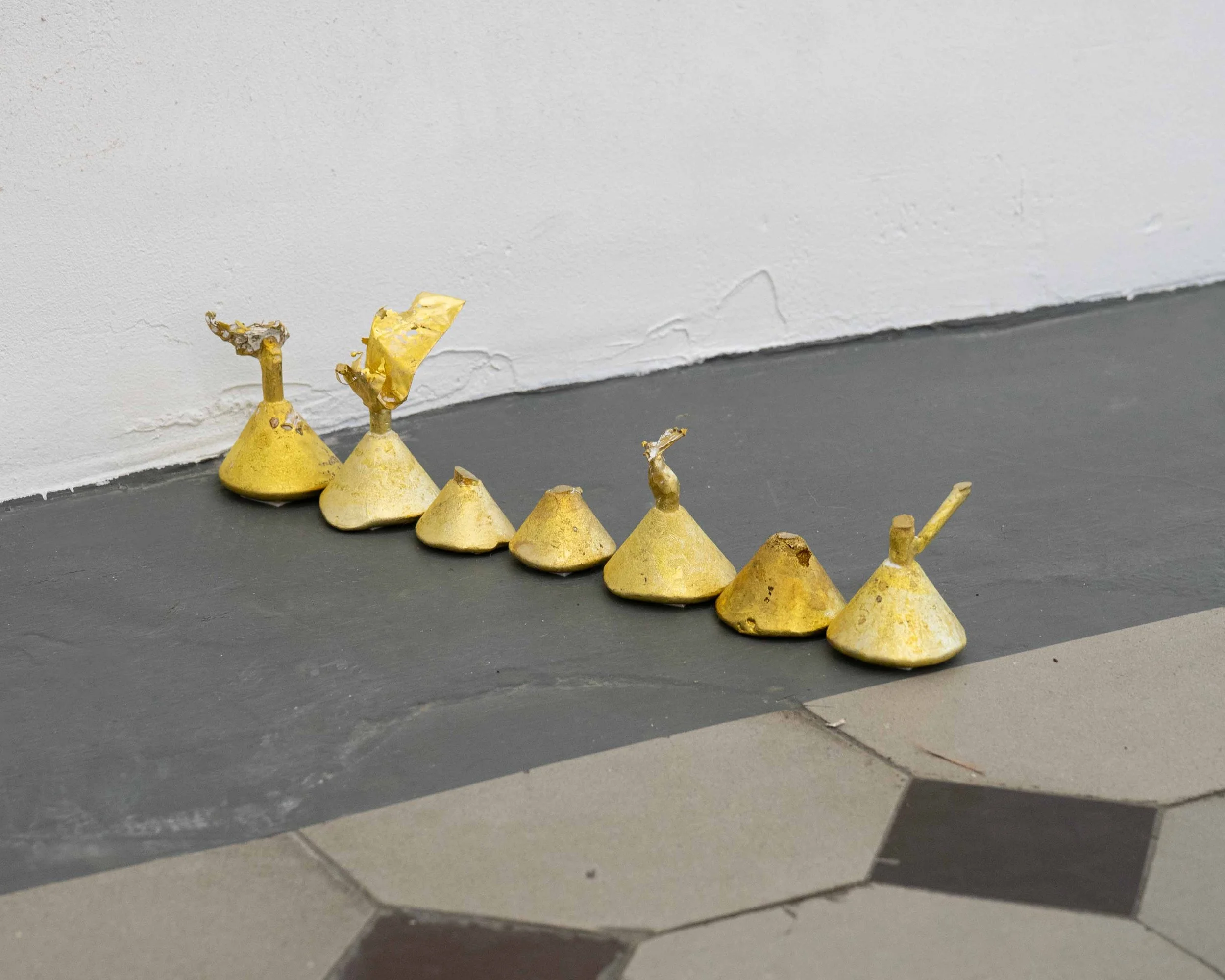
Juliana Lindenhofer, Untitled, 2025, installation view of She put the butterfly on the door and said spring has now arrived at Draakon Gallery, Estonia. Photo: Anna Mari Liivrand